 Hib Halverson
by Hib Halverson
Photos by the GM Small-Block Team and the Author.
7 July, 2024
Like many Corvette Action Center members that day, I watched the 2025 ZR1 reveal video. Prior to the introduction, GM had been teasing the car as “unthinkable.” When they announced that the LT7 engine produces 1,064 horsepower, I almost spit coffee all over my computer displays. I thought, “Wait–what?!” For a year or more, scuttlebutt about the C8 ZR1’s LT7 engine–sometimes I call it “Big Gemini”–was 800-850-hp.
Small-Block Global Chief Engineer Jordan Lee and LT7 Chief Engineer Dustin Gardner, along with the entire Project Gemini team, blindsided the automotive media segment that covers GM engines. When the SAE-certified, power and torque figures were announced, about all most of us could think was, “Holy s**t!” or “WTF?!”
The complete performance specs are: 1064-hp at 7000 RPM and 828-lbs/ft torque at 6000 RPM–more than three horsepower per cubic inch, 3.17 to be exact.
Unthinkable, indeed!
That the Small-Block Team managed to fool all we “engine guys” in media who cover Corvette was well-played. After the engine was public, Jordan Lee told me that he, Gardner, and the rest of GM’s Smallblockers were entertained by the rampant speculation on the Interweb about the “850 horsepower engine” coming for the ZR1 when they already knew the power level was 1000+.
Many CAC members, craving information about the unthinkable 1064-horsepower C8 ZR1, have long since read about it here or on social media. It would make little sense to post what you already know, so we queried our sources for secrets of the LT7 you may not find elsewhere.
Louise is a Certified Screamer
The two 5.5-liter, flat crank DOHC “Gemini” V8s share only one feature with pushrod Small-Blocks, and that’s the cylinder bore centers that are 4.40 inches apart. Nevertheless, Chief Engineer Lee told us, “It does have 4.4-inch bore centers. That’s part of the Small-Block DNA that goes back over 70 years, and we carried that over to the LT6 and LT7 engines. They are not Small-Blocks in the conventional sense. Architecturally, they are a lot different, but the Small-Block Team designed and engineered the Gemini twins, so by virtue of that and the 4.40 bore centers, they are Small-Block engines.”
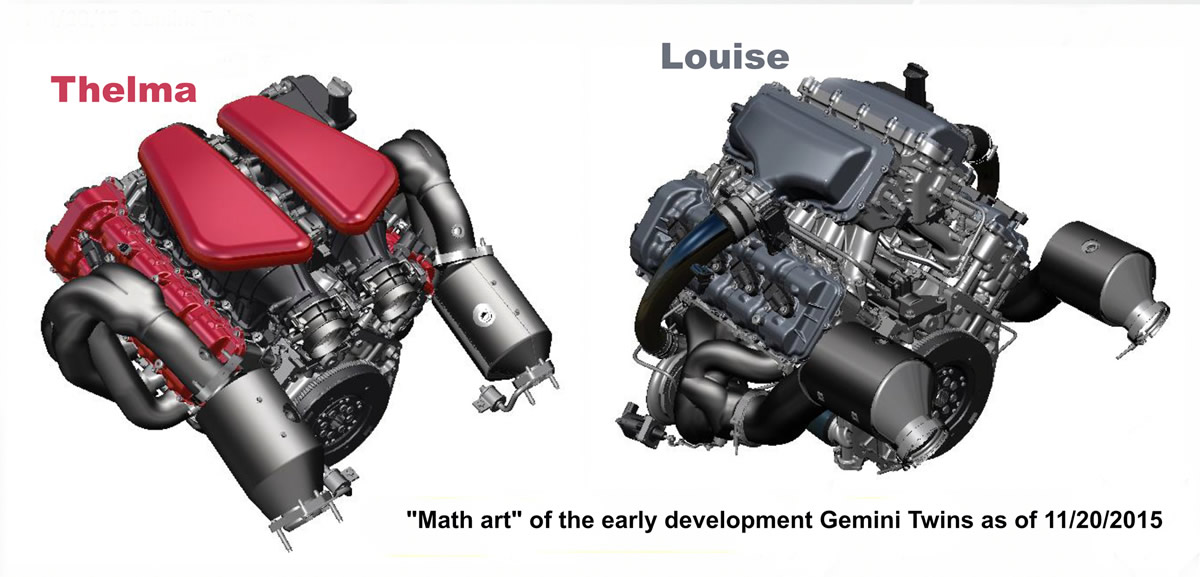
“Math art” of the early development Gemini Twins as of 11/20/2015
Image: Small Block Team edited by Author.
The GM Propulsion Systems Engineering Center in Pontiac, Michigan, has about 100 dynamometers. Three of them are Horiba GM-LI700 1000-hp engine dynos paired with AVL MMD exhaust emission analyzers. These pieces of equipment were acquired specifically for testing and validation of Project Gemini’s two engines, the Z06’s LT6 (during development, code-name “Thelma”), and the ZR1’s LT7 (code-name “Louise”).
Aware that “Thelma and Louise” the movie ends with the two girls’ demise, I was curious about the code names. I asked Jordan Lee about them. He stated, “They came from just a bunch of engineers kicking around’ funny code names. I think we took a vote. “Thelma” and “Louise” were the winners. Funny–we didn’t think much about the end of the movie. The names just seemed to fit. Louise was a ‘bad ass’, LT7; Thelma was a ‘sweeter bad ass’, LT6.”
In Spring 2024, the final LT7 dynamometer session tested peak torque and power according to the Society of Automotive Engineers (SAE) stringent J1349 standard. “SAE-Certified” specifications would be used for publicizing the ’25 ZR1, which at that time was undergoing final development and validation by the Corvette Team.
SAE J1349 requires a three-test average for each certification. LT7’s amazing performance numbers came from a series of wide-open-throttle (WOT) “step” tests run on one of the Horiba dynos. Checking points were every 500 RPM. From about 1000 to 6000 RPM, at each point, RPM was held for five seconds for the engine and the dyno to stabilize, then ten more seconds while torque output was recorded. Dynos measure torque output. Their software derives horsepower using the conversion: horsepower = (torque x rpm) ÷ 5252.
Once the testing reached 6000 RPM, Louise was so powerful that engine speed and torque absorption pushed the dyno near its temperature limits. At that point, the process became far more lengthy because 10 minutes of engine idle time had to be inserted between test points to allow the dyno to cool. From 6000 RPPM to 8000 RPM, rather than 15 seconds, each step took over 10 minutes.
“(Before certification) There were calibration runs and spot checking points,” Jordan Lee, told us in late November 2024, “to dial in calibration variables like spark (advance), fuel (delivery), (cam) phaser timing, injection timing, and so forth. Once calibration was dialed in, runs were made according to the SAE procedure.
“Not only were these tests time-consuming, but there were other issues,” Lee continued. “Before certification, during development, we discovered the LT7 was putting a lot of heat into the dyno exhaust. We had to add water cooling to its exhaust stack to prevent overheating. On the evening of the first day’s testing, we were the only engine running. The facilities guys showed up at the dyno console. ‘Our emissions scrubbers and temperature levels are going crazy,’ they warned. ‘What the heck are you guys doing?’ They wanted to shut us down. We convinced them that would be a bad idea.”

April 15, 2024. The first production LT7 at 7000 RPM in dyno cell D106 during SAE Certification testing. We “engine guys” get off on the exhaust glowing bright red. Image: Small Block Team.
The second day of SAE certification tests was April 15, 2024, which will likely be remembered by all involved because it was both tax day and LT7 certification day. That afternoon, at the control console for Dyno Cell D106, clustered around the operator, Darius Reed, were calibration engineers Wes Haney, Jason Dvorscak, and Julie Starr. Anticipation and tension were running high. Over a decade of design, development, and validation had gone into this engine. At minimum, they had to beat the 2023 Dodge Demon 170’s 1025 horses.
LT7’s peak torque had already been certified at 828 lbs/ft. at 6000 RPM. In fact, its torque curve was at 800 lbs/ft or a little over from 3000 to 6750 RPM, giving the phrase “stump pulling torque” a whole new meaning.
It was time to go big or go home. The LT7 had run two of the three tests required. Now it was ready to run at 7000 RPM one last time, needed to certify SAE maximum power.
Still in the 10-minute cool-off, the LT7 idled on the dyno.
The “cal” engineers, having finished their part art and part science, were texting play-by-play to Lee and Gardner.
The cool-off ended.
1434 hours, 15 April, 2024.
Reed clicked his mouse, and that final, computer-controlled test began. Louise screamed at WOT 7000 RPM. A second later, they had an average: 798.3 pound/feet torque. The horsepower number was an SAE-Certified, one thousand sixty-four! There were high-fives and fist-bumps all around.

August 31, 2024. At the National Corvette Museum, GM Chief Engineer for Small Block Engines, Jordan Lee, addresses attendees during an “LT7 Deep Dive” seminar. Image: Author.
“Through Wes’s, Jason’s, and Julie’s work, it came in at ten sixty-four.” Jordan Lee told the audience during an August 2024 LT7 seminar at the National Corvette Museum after the conclusion of the 2024 Corvette Caravan, “We were stunned. It was a historic power figure, making that engine the world’s most powerful in a volume production car.
“I’ve known this number since April (2024), and I’m still stunned,” Lee beamed. “It’s an incredible power number for a gasoline engine. Competitors, like the million-dollar Ferrari, SF90 Stradale, don’t even come close to a thousand sixty-four, and that includes their electrification. Most of the exotic car V8s are in the high 700-horsepower range.”
Note to foreign supercar drivers: Louise has a 1064 hp mean streak. Don’t piss her off.

A graph of how other noteworthy Corvette engines compare to the LT7. Image: Small Block Team.
Boss Buys-In
Researching LT7 backstories, we were surprised to learn that early studies of what became the Gemini Twins began seventeen years ago. Jordan Lee told the CAC during a November 2024 interview, “We knew, even before C7 launched, that C8 would be mid-engine. The ‘Advanced Architectural Engineering’ is a group in GM that studies future stuff. In 2010, the late Ed Romblom, one of the most exceptional engine engineers I’ve worked with in my carrer at GM, led a part of that group that explored DOHC V8s–asking questions like: could we adapt the Small Block architecture or do an all-new engine?”
Wait–what? A “deja vu” moment? The question Jordan described was the same question–adapt the SBV8 or do a new engine–that was asked 40 years ago when the first LT5, used in the ’90-’95 ZR1, was in the concept stage.
“By 2013,” Jordan continued, “we knew (C8 Z06 and ZR1) would get a new, double overhead cam V8. We studied bandwidth–if we did one for Cadillac in a front-engine car, would it have enough bandwidth to meet the power levels we wanted in a Corvette, especially a ZR1?
“The answer was, ‘No,’ ”
Whew. We dodged a bullet there didn’t we?
Lee continued, “We couldn’t get the bore size and power levels we wanted while having a smaller displacement for other applications, so the architecture split. The 4.2-liter LTA for Cadillac’s short-lived, 2019-20 CT6-V went one way, and the Geminis went the other.”
“C8 work really picked up after C7 launched in ’14,” Lee added. “By late ’14 and early ’15, we were finalizing architecture and projected performance. When a concept engine gets close to becoming an actual program, we have reviews to advise senior leadership what we have in mind and a rough idea of cost.
“We had reviews with Mark (Reuss, President of General Motors). He had a vision of what he wanted the cars to be. It included a high-power, naturally-aspirated engine for Z06 and a high-power, boosted engine for ZR1. As we identified costs and areas on which we needed to focus,” Lee states, “I let him know, in no uncertain terms, ‘Mark, this is going to be a really expensive engine. If you really want to go after the other exotics with super high levels of performance, it’s not going to be cheap, so is this a no-holds-barred project?’
“Mark was clear in his direction. He had become enamored with the Gemini architecture. He took the handcuffs off. (Reuss’s position was) Don’t worry so much about the cost. Just give me the best, no-compromise engines. So–we had our direction, and we ran with it.”

May 4, 2016. At the Pontiac Engineering Center, Engineers and Technicians assemble the first development, or “beta,” version of the LT7. This first, physical iteration of Louise looks much like the math art in a previous photo. Image: Small Block Team.
With the Small Block Team’s objectives backed by the second-highest authority in GM, by mid-2015, the Gemini Twins, Thelma and Louise, moved from concept to development.
Some Challenges
Goals in developing Big Gemini were not only making unthinkable torque and horsepower, but also conquering the troublesome, second-order vibration inherent with flat-plane crank V8s. Registry members who have driven Z06es or ZR1s know that those at GM on both the engine side and the vehicle side did bang-up jobs meeting that noise and vibes challenge.
Another demanding task was perfecting engine lubrication–engineers call it the “lube system”–such that a consistent, non-aerated supply of oil was supplied to bearings, piston oil squirters, turbos, and valvetrain under all operating conditions.

Math art of the LT7 seven-stage dry sump pump. With all the reliability/durability design and testing in this part, it’s pretty unlikely that one will fail. But…if it does, replacement dry sump pumps are obscenely expensive. Image: Small Block Team.
“LT6 and LT7 share lube systems,” Lee explained. “Early in the program, the lube system for both was the most challenging. The dry sump was much different (than previous GM dry sumps), which only had one scavenge pump. We have six scavenge pumps in the LT6 and, in the LT7, one more for the turbos.
“Getting the performance out of that scavenge pump system–the different (crankcase) bays, balancing how much vacuum we were pulling on each cavity, oil control, aeration control, scavenging the cylinder heads–all that was, without a doubt, an engineering-intensive exercise.”

More math art of the lube system passages cast into the LT7 cylinder block and heads. “Bays” are the spaces in which each crankshaft journal rotates. There are seven scavenge stages: four for crankcase bays, one for the left head and the high-pressure fuel pump cavity between the heads, one for the right head and the front cover, and the last for the turbos. Image: Small Block Team.
Fun fact about the Gemini lube system: Lee told me that he couldn’t believe that, during the LT6 media briefing back in February of ’22, no one–not even this supposedly “observant” writer–asked about the seventh unused scavenge pump inlet in the bottom of the LT6 oil pan, ie: if the LT6 has a six-stage pump, what’s the extra inlet for? None of us noticed that.
Another issue early in the program was the throttle bodies. The early Louise design had the two throttle bodies between the turbo compressors and the charge air coolers (CAC). Development engine tests revealed that no matter what was done to the throttle bodies, their reliability/durability was compromised by turbo outlet temperature. That forced a major change that moved the two TBs to cooler spots between the two CACs and the intake plenum.
Taming Turbo Lag
With a turbocharged engine, the time between throttle opening and usable manifold pressure increase is known as “turbo lag.” It’s caused by a delay in torque delivery while exhaust flow accelerates or “spins up” the turbocharger’s turbine wheel. This lag was another challenge facing the Small Block Team during the LT7 development.
Turbo engines with long distances, restrictions, or poor flow control between the exhaust manifold outlet and the turbo’s compressor inlet will have significant turbo lag. To the extreme, there are aftermarket, rear-mounted, turbo kits for older Corvettes with lag that could be benchmarked with a sundial.
-

- The right side of the right-hand LT7 maniturbo. Image: Small-Block Team.
-

- Front view of the right maniturbo. Image Small-Block Team
“A number of engineering strategies reduce lag,” Assistant Chief Engineer, Dustin Gardner, stated in the November 2024 interviews, “Integrated, cast stainless steel, exhaust manifolds and turbo housings (known as “maniturbos”) position the turbine wheels very close to the exhaust valves so energy gets there faster. The turbo shafts ride on ball bearings, reducing friction so turbo acceleration is quicker. The charge air coolers (CAC) are packaged on the cam covers, yielding a short path from the compressors through the CACs to the intake plenum. The intake is designed with (much less) volume than the LT6 intake. All of this results in minimal air to compress, leading to faster building of boost. There are electric waste gates, (solenoid-operated) compressor bypass valves, and turbo speed sensors, all big enablers for two active control strategies.”
Dustin continued, “First, ‘steady state anti-lag control’–when the engine is at elevated speeds, but relatively low loads, cam phasers, waste gates, and bypass valves move to optimal positions to rapidly build boost when the driver wants it.
“Second: ‘Dynamic boost control’–this is where the magic is. During aggressive driving, when the driver lifts, the engine remains at high speeds, making little, if any, torque, but we maintain air flowing through the turbos. Using the waste gates and bypass valves, the engine controls maintain turbo speed, and thus, boost in the charged portion of the system ahead of the throttles. Then, when the driver tips back in after a braking event, the boost is already there. This makes the torque build of the engine very linear and natural feeling. It’s a big enabler for the LT7’s great drivability during aggressive driving.
“These systems were perfected throughout the course of main engine calibration. New algorithms and control strategies were developed from scratch by the team and integrated into the engine control software.”
Bottom line: run her hard, and Louise is a lag-less, wonder woman.
Bots Lash the Valves

LT7 cylinder heads are not finish-machined at the PBC but are done by a GM supplier off-site. Image: Small Block Team. Image: Small Block Team
The Gemini Twins are assembled in the Performance Build Center (PBC) at GM’s Bowling Green Assembly plant. Both have solid lifters, so there must be some “lash” between cam lobes, finger followers, and valve stem tips. Setting this valve lash demands far greater precision than how we did it in the old days: with a feeler gauge and subjective opinion of the resistance as that gauge moved between the rocker arm and the valve tips.
At PBC, a robot sets the valve lash. “There are two precision spheres at the tips of a ‘caliper-like’ measuring device,” Dustin Gardner explained. “These fit into the radius of the gap on both sides of the cam-to-finger-follower interface. The spread of these two spheres is then translated into the gap. We have a setup to measure that without any shim. That dimension is used to select the shim. We have two other setups to make sure it’s right: after the shim is installed on the head, then again, after the head is bolted to the block.”
More Fun Facts
So, what of the 2023 Dodge Challenger SRT Demon 170? To make 1025 hp, its supercharged 6.2-liter V8 requires 85% ethanol and 15% gasoline (E85). On straight pump gas, it makes only 900 hp. The 5.5-liter, twin-turbo LT7? No E85 required. Its 1064 horsepower comes with good, old 93 octane pump gas.
Speaking of fuel, Louise has a “gasoholic” problem. At peak power, she sucks two gallons of gasoline per minute. If you started with full tanks and drove a ZR1 at wide-open throttle until you ran out of gas, it would be a short, nine-minute trip during which you could easily see the gas gauge move from “F” to “E”. In the Fall of ’24, at Germany’s Papenberg test facility, Mark Ruess drove a development ZR1 to a 233.29 MPH two-way average. GM released video footage of Ruess’ top speed test. It starts with Hendrick Motorsports Vice Chairman, Jeff Gordon, standing behind a guardrail. He watches Ruess rocket by at top speed, then turns to the camera and quips, “Holy Crap. That’s fast!”–that from a guy with four NASCAR Cup championships and who, for 22 years, ran 200+ in a Cup car at Daytona and Talladega.

Math art of LT7 fuel system parts. Image: Small Block Team
Each Papenbuerg test run was from 185 MPH until the car wouldn’t go any faster. Nearly three gallons of fuel were used in just those two, 40-sec. runs. What kind of fuel system does Big Gemini need to support that much fuel consumption? Expanding upon a feature first used on the second LT5 in the ’19 ZR1, the LT7 has both exhaust side direct injection (DI) and port fuel injection (PFI). The direct injectors spray fuel at 5076 PSI in six plumes, and the port fuel injectors, mounted in two, single-piece fuel rails, spray at 58 PSI with a dual-plume pattern. Each injection system is controlled independently for best combustion, lowest emissions, and highest engine performance. Additionally, the port injection system eliminates the possibility of oil vapor causing soft carbon deposits of the backside of intake valves, a problem that occurs in some DI engines.
If you’re asking, “How come the LT7’s rev limit is only 8000 RPM, but the LT6 runs to 8600 RPM?” Well, LT7s have heavier piston and connecting rod assemblies to ensure reliability/durability at the higher cylinder pressure created in a boosted engine. The heavier parts required the LT7 rev limit be lowered by 600 RPM.

A Gemini Rocket embossed on the front of the left cam cover. Image: Author
Fifty-nine little “Gemini Rockets” are embossed in places on and inside the engine. Interestingly, they’re on piston tops to identify the direction piston/rod assemblies are to be installed. About those rockets–the program’s code name, “Project Gemini,” was inspired by early manned space flight, specifically the Gemini program during which two astronauts did 10 missions in low Earth orbit during 1965 and 1966. Gemini was a prelim to the Apollo moonshot. Like the program that first landed men on the Moon, GM’s Gemini engine program was a moonshot. Lastly, the LT6/LT7 project’s name was also inspired by the many astronauts who have been Corvette enthusiasts and owners..
At peak power, exhaust flow out of a ZR1 is so great that it produces 37 pounds of thrust. When a ZR1 goes by at high RPM, it doesn’t sound like a car at all. It sounds like an F-16 on a low pass at an air show.
The turbos have 3-inch diameter compressors–the largest used on production gasoline engines. They spin at up to 137,000 RPM. Imagine the centrifugal force acting on the compressor blades at 137K RPM. We don’t know the number but, suffice to say, it’s a s**tload of force. Turbocharger exhaust inlet temperature can reach 1900°F. Turbine wheels are made of a vacuum-cast, nickel-chromium superalloy, “Mar-M 246”, with an operating temperature of 1200-1900°. Under very aggressive driving, the turbos produce 24 psi boost; otherwise, boost is around 20psi. Popular of late are “twin-scroll” turbos; however, LT7 turbos are single-scroll, better for maximum airflow and peak horsepower.
LT6 and LT7 forged titanium connecting rods are made by Pankl Racing Systems in Austria. Pistons for both are made by CP-Carillo in Irvine, California. Their titanium intake valves are made by Del West Engineering in Valencia, California. The exhaust valves are made of “Nimonic 80” another nickel-chromium superalloy common in severe-duty exhaust valves. The camshaft finger followers, also manufactured by Del West, are diamond-like-carbon-coated steel. Their design was based on those used in GM Racing’s 2.2L V6 turbo Indy Car engines.
The LT7 engine controls have a lot going on and require robust computer hardware. The engine control module is a GM E68, which has a three-core processor running at 3 MHz. The E68 has 512 Kb RAM and 8 Mb flash memory.

Hundreds of signatures are on the “Certification Engine.” Image: Small Block Team
The LT7 used for SAE certification was signed by everyone who worked on the Gemini Project. First, it will be loaned to the National Corvette Museum. After that, it will go on permanent display at the GM Heritage Center.
Acknowledgments
We’d like to thank Assistant Chief Engineer Dustin Gardner, calibration engineer Jason Dvorscak, and E68 Staff Software Engineer Paul Zombory for their help in researching this article. Also, we are grateful to Kyana Donaldson, Manager, Chevrolet Communications, for her assistance.
From the start, Small-Block Chief Engineer Jordan Lee backed us up on this story. Super kudos to him for that support.
Hib Halverson has been a content contributor to the Corvette Action Center since it started. He’s the former owner of a Dark Purple Metallic ’95 ZR1 (“Barney”). He and his wife, Sandy, currently own a ’12 Z06/Z07 (Blue Bullet), a Racing Yellow ’19 ZR1 (the “Bad Assed Bee”) and a Hysteria Purple ’26 Z06 (“Barney 2”). Halverson’s real job is writing for “Corvette Magazine” and other Internet clients. He lives in Goleta, California, with Sandy and a cat named “Zoey”.